Winter
Kevin the Star StrikerWinter is more than a season in the Wild Soccer Bunch’s story. It becomes a physical barrier, an oppressive mood, and an opponent that the children try to resist through imagination, improvised training, and finally a return to competitive play. By extending deep into April, Winter delays the freedom of spring break and forces the team to discover that being a team means continuing to act together even when the soccer field is unreachable.
Definition and Setting
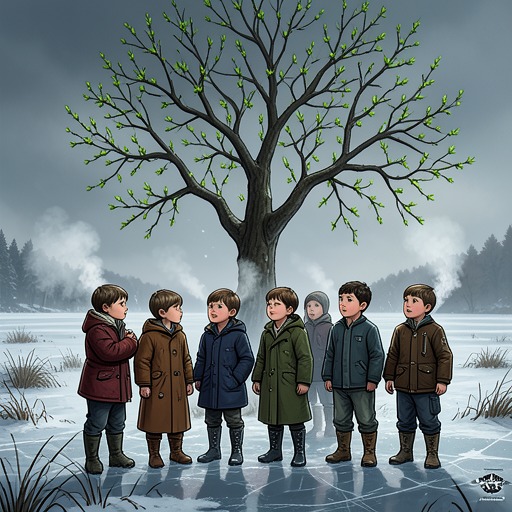
Winter dominates the north side of Chicago with frozen ground, snow, and a wind so forceful that the city is known as The Windy City. The soccer field is covered by at least seven inches of snow and ice, while the cold makes ordinary outdoor play impossible. The season is described as eternal and never-ending, giving it the scale of a ruling power rather than a temporary change in weather.
The timing makes the conditions especially cruel. Spring break is only days away, and the children expect two weeks of soccer from breakfast until sunset, interrupted only by lemonade from Larry’s stand. Instead, Winter reaches far into April. The cleats they received for Christmas make their feet itch because they cannot use them, and the field that should mark the beginning of their holiday remains buried beneath snow and ice.
Confinement and Collective Frustration
Winter first drives the children indoors. Kevin and Tyler sit by their window on Wilson Street, looking through ice crystals at the grey sky while Kevin’s scratched and scuffed soccer ball rests on his lap. Their imagined hibernation quickly becomes a feeling of captivity: they compare themselves not to peacefully sleeping grizzlies but to caged tigers at the Lincoln Park Zoo. The comparison captures Winter’s psychological effect. It does not merely prevent a game; it traps the children inside the lives they want temporarily to escape.
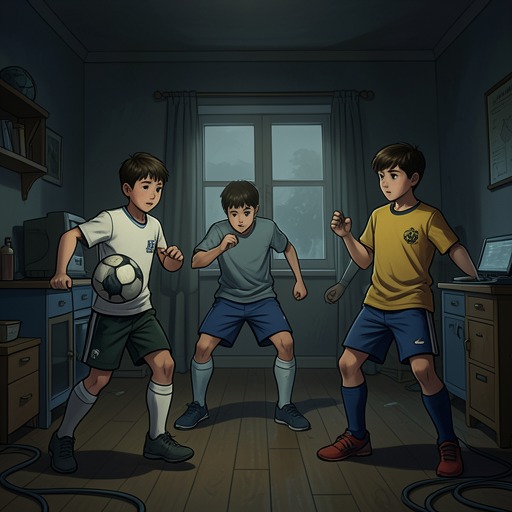
The frustration produces a chain of improvised indoor matches. Kevin and Tyler throw the ball between them as makeshift goalie training, then kick it against the wall. Danny does the same at 44 Dearborn Street. Julian and Josh fire the ball against a wall across the street, while Alex turns a small open space between a mirror and a china cabinet into a goal at One Woodlawn Avenue. The repeated impact of the ball creates a series of drum rolls across the neighborhood, linking separate houses through a shared refusal to become inactive.
Even Roger, who is being subjected to the humiliating ordeal of having curlers put in his red hair by his mother’s friends at his town house on Oak Park Avenue, draws strength from hearing those distant sounds. Winter therefore creates separation while also generating a new form of connection. The children cannot occupy the same field, but the repeated rhythm of the ball lets them imagine themselves as one group.
Winter as an Opponent
The children eventually treat the weather as something that can be challenged. When fist-sized snowflakes continue striking the windows only three days before spring break, the sky appears determined to smother everything beneath it. Yet the drum rolls grow louder. The damp snow also foreshadows a thaw, so the same weather that seems to imprison the children begins to signal its own weakening.
Two days before the holiday, sunlight finally breaks through a narrow opening in the stone-grey sky. The last snowflakes dance in the light, and the ball continues moving between Kevin and Tyler’s feet. Their room has become Toyota Park in imagination, even as their indoor shooting destroys model planes hanging from the ceiling. Winter has not yet vanished, but its authority has been interrupted: play has continued by transforming domestic space into a soccer field.
That resistance does not immediately succeed. After Alex’s grounding and the team’s other troubles, the following day remains bleak. At school, children happily discuss their spring-break plans, while the Wild Soccer Bunch has nothing to report. On the way home, the neighborhood appears drained of color, and the team walks slowly through slush while water drips from roof icicles. They gather at the locked soccer field, where the snowy pitch, burdened trees, and closed lemonade stand make the lost holiday visible.
Defeat, Return, and Reversal
Winter’s clearest apparent victory comes when the children admit that their attempt to drive it away has failed. The field remains unusable, spring break seems ruined, and even being grounded no longer matters because there is nowhere to play. The group sits on the old bleachers in defeat. In earlier years, Larry would have opened his stand on the last day of school and the children would have begun two weeks of continuous soccer; now the only available activity is building a snowman.
The season’s defeat is ultimately temporary because the children’s resistance has prepared them for the match that follows. They train for twelve days on soft, muddy ground, converting another hostile condition into an advantage. When rain finally falls during the decisive game, the Unbeatables slide across the field, but the Wild Soccer Bunch moves confidently because the mud resembles the conditions in which it has practiced. Winter’s legacy is therefore paradoxical: it cancels the holiday the children wanted, yet the enforced period of confinement and difficult training helps produce the skill and unity needed for their comeback.
The match turns the seasonal conflict into a collective reversal. The Wild Soccer Bunch begins behind, but coordinated passing, individual recoveries, and persistence carry the score from seven to four to seven to seven, then to an eight-to-seven lead and a ninth goal. The game reaches nine to nine before Roger scores the deciding goal. The children then carry Roger across the field, while Kevin remains lying in front of the goal in disbelief. The victory does not erase the earlier snow, disappointment, or lost holiday, but it proves that Winter has failed to destroy the group it confined.
Narrative and Thematic Significance
Winter functions as the story’s first large-scale antagonist because it attacks the team without belonging to either side. Mickey the Bulldozer and the Unbeatables later claim that the soccer field belongs exclusively to them, but Winter has already made the field inaccessible to everyone. Against both forms of exclusion, the children create alternative spaces and rules: bedroom walls become goals, the neighborhood becomes a network of play, and training continues despite the absence of a normal pitch.
Its imagery also shapes the emotional rhythm of the narrative. The grey sky, snow, ice, slush, locked stand, and silent walk to school establish disappointment, while the widening crack of sunlight and the growing drum rolls introduce the possibility of renewal. Winter is defeated neither by a single act of force nor by a miraculous change in weather. It is overcome through repetition, shared imagination, and the decision to keep playing until the team can return to the field. In that sense, Winter tests the Wild Soccer Bunch before the final match does: it asks whether soccer is only a place and a season, or whether the team can carry its game, discipline, and solidarity through conditions that seem designed to end them.